logo

Free Shipping Over $150.00

View Free Shipping Details

Product Search
Embraer E2 190/195 - General Familiarization - Trans Global Training

Embraer E2 190/195 - General Familiarization - Trans Global Training


$516.00
SKU 1331-TRAN-Tgray stars
Qty

Product Features

  • Publisher: Trans Global Training
  • Time: Self-Paced: +/- 40 hours

General Familiarization
Course Preview (Not Actual Course)

This General Familiarization course of the Embraer E2 190/195 with PW1900G powerplants is designed to give you a complete technical overview of all aircraft systems as outlined in the systems description section of the aircraft maintenance manual. It is a great tool for the training of new AMTs in base and line operations, for review, and for interview preparation by those seeking employment.

This self-paced course provides a complete technical overview of each system, including component location, operation, and maintenance needs, plus all cockpit and remote interfaces. Click below on "Detailed Course Contents" for a full Table of Contents.

Upon completion of the course, you will be able to:

  • Identify safety precautions related to the airframe, its systems, and the powerplant.
  • Identify maintenance practices important to the airframe, its systems, and powerplant.
  • Define the general layout of the aircraft’s major systems.
  • Define the general layout and characteristics of the powerplant.
  • Identify special tooling and test equipment used with the aircraft.

Trans Global Training General Familiarization courses are produced for ATA 104 and EASA Part 66 Level 1+. Each is a Powerpoint type presentation divided into ATA sections. A chapter quiz following each section allows you to proceed to the next. With your successful completion of all chapters, a serial numbered certificate is issued in your name.

On average, the course duration is 40 hours, however, this will vary based on your experience and study habits. From the time you begin, you will have 1 year to complete and review the course.

Shortly after your purchase, you will receive 2 emails; The first from ATB will be your receipt. The second from Trans Global Training will be your login credentials. If these do not appear within moments of placing your order. Please check your spam files or contact us for assistance (email: techsupport@actechbooks.com or phone: 1 970 726-5111).


FAAST AMT Award Points:
This course qualifies for 40 FAA FAAST AMT Award Points, which will be issued upon your successful completion. To receive this award, you must have an account with FAAST. If you are not yet a FAAST member, your free registration can be found at https://www.faasafety.gov/login/reg/register.aspx


IA Renewal Credit
In addition, this course qualifies for 8 hours of IA Renewal Credit. If you hold Inspection Authorization (IA), this course serves as the entirety of your annual continued training requirements. Upon your successful completion, ATB will authorize this credit through the FAA and a printable IA certificate of accomplishment will be made available at https://www.FAAsafety.gov


For Training Managers:
Self paced training is a great option for your continued and recurrent needs. It is economical, efficient, and allows your team to proceed on their own or during down times, thus without the need to pull them away from the job. Contact us to discuss ways to integrate this method into your training programs.

Additional features allow for the assignment of a training manager within your company, allowing oversight of each trainee's progress throughout the course including time spent, sections completed and a record of current/incorrect quiz responses.


  • ATA 00 - Introduction
    • Covers the development history, design philosophy, and general characteristics of the E190-E2 and E195-E2 including evolution of the E2 program; basic configuration, dimensions, performance and certification standards; cargo and cabin layouts, zoning, and access panel identification; summary of major systems including avionics, engines, APU, air management, fuel, hydraulics, brakes, flight controls and landing gear; outlines standard ground handling, servicing and maintenance concepts; identifies electronic equipment bay locations and major components.
    ATA 21 - Air Conditioning
    • Covers the operation, control, and maintenance of the aircraft’s environmental control systems, including air conditioning, pressurization, temperature regulation, ventilation, and air quality management.
    ATA 22 - Autoflight
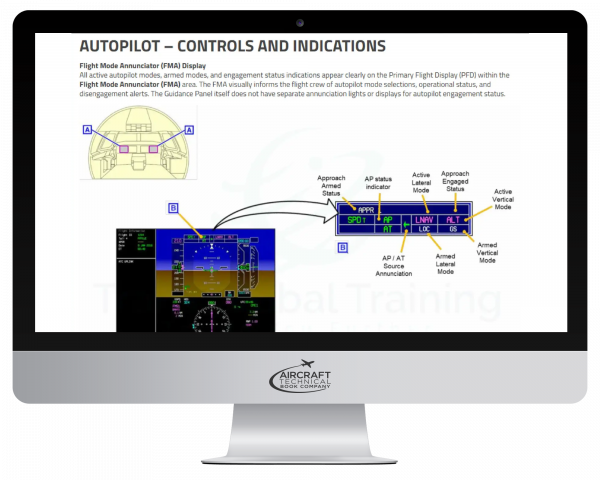
    • Covers the Automatic Flight Control System (AFCS) and its integrated functions for automatic control of aircraft flight path and thrust, including redundancy features, controls, and operational modes.
    ATA 23 - Communication
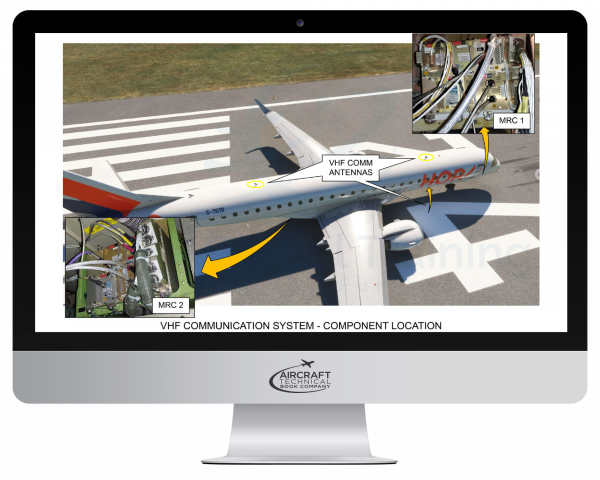
    • Covers aircraft communication systems for voice, data, and interphone operations, including cockpit audio integration, external communications, and ground crew interfaces.
    ATA 24 - Electrical Power
    • Covers the Electrical Power Generating and Distribution System (EPGDS), including normal, auxiliary, emergency, and external power sources, power conversion, and distribution control.
    ATA 25 - Equipment and Furnishings
    • Covers cockpit, passenger cabin, galley, lavatory, emergency equipment, insulation, and furnishings systems, including their layout, operation, and integration with safety features.
    ATA 26 - Fire Protection
    • Covers detection, indication, and extinguishing systems for engines, APU, cargo compartments, lavatories, electronic bays, and cabin areas, as well as portable and automatic extinguishers.
    ATA 27 - Flight Controls
    • Covers fly-by-wire controlled primary surfaces—ailerons, elevators, rudder, and multifunction spoilers in roll augmentation mode—along with their control laws, redundancy, and built-in protections, high-lift devices (flaps and slats), spoiler systems in speed brake and lift dump modes, horizontal stabilizer trim, and ground spoiler operation.
    ATA 28 - Fuel System
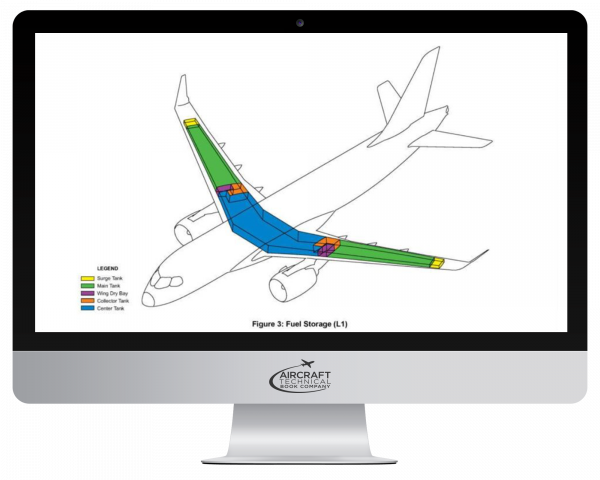
    • Covers the storage, distribution, transfer, refueling/defueling, and indicating systems that supply fuel to the engines and APU, as well as associated control, monitoring, and warning functions.
    ATA 29 – Hydraulic Power
    • Covers the three independent hydraulic systems supplying power to primary flight controls, landing gear, brakes, thrust reversers, and other aircraft systems, including redundancy, backup power sources, and ground servicing.
ATA 30 - Ice & Rain Protection
  • Covers systems that prevent or remove ice, frost, and rain from critical aircraft surfaces and components, including wing and engine anti-ice, windshield and probe heating, water/waste freeze protection, and ice detection.
ATA 31 - Indicating and Recording Systems
  • Covers the aircraft’s indicating, alerting, recording, and display systems, including central warning functions, cockpit panels, avionics architecture, and built-in test features.
ATA 32 - Landing Gear
  • Covers landing gear structure, operation, control systems, braking systems, nose wheel steering, position indication, and emergency extension, including related safety features and maintenance provisions.
ATA 33 - Lighting System
  • Covers the aircraft’s interior, exterior, and emergency lighting systems, including control locations, operating logic, and integration with other systems for normal and abnormal conditions.
ATA 34 - Navigation
  • Submodule 1 Covers the Air Data System (ADS), Integrated Pitot/Static/Angle of Attack (AOA) system, Air Data Computers (ADCs), Integrated Electronic Standby System (IES), and Total Air Temperature (TAT) sensors, including controls, indications, redundancy, and failure management. Submodule 2 covers navigation systems reliant on external signals, including VHF NAV (VOR, ILS, LOC, GS, MB), DME, transponder (Mode S/ADS-B), TCAS, weather radar, EGPWS/windshear detection, and GPS. Submodule 3 covers navigation systems that operate without external references, including the Inertial Reference System (IRS), Attitude and Heading Reference System (AHRS), and standby compass. Submodule 4 covers the integration of navigation and performance data for route planning, guidance, and optimization via the FMS.
ATA 35 - Oxygen
  • Covers the crew, passenger, and portable oxygen systems, including oxygen storage, delivery, activation logic, controls, monitoring, safety features, and testing.
ATA 36 - Pneumatic Systems
  • Covers the aircraft’s pneumatic system architecture, operation, control, and monitoring, including engine, APU, and external air supply, as well as integration with other aircraft systems such as anti-ice, air conditioning, and potable water pressurization.
ATA 38 - Water and Waste Systems
  • Covers potable water supply, waste collection and disposal, air supply, freeze protection, component control, servicing, and monitoring systems.
ATA 44 - Cabin Systems
  • Covers systems that provide cabin communication, passenger announcements, cabin monitoring, environmental control, and security surveillance.
ATA 45 - Maintenance Diagnostic Systems
  • Covers the Central Maintenance System (CMS) architecture, functions, data recording, wireless and wired access methods, and integration with aircraft subsystems for fault detection, diagnostics, and maintenance support.
ATA 46 - Information Systems
  • Covers the aircraft’s Flight Deck Information Systems, focusing on the Electronic Flight Bag (EFB) and its integration with avionics and wireless communication systems.
ATA 47 - Inert Gas Systems
  • Covers the systems used to generate, distribute, and control Nitrogen Enriched Air (NEA) for fuel tank inerting, including air preparation, gas separation, flow distribution, monitoring, and overheat/leak detection.
ATA 49 - Auxiliary Power Unit (APU)
  • Covers the APU and its subsystems providing electrical and pneumatic power, including control, fuel, ignition/starting, air, indicating, exhaust, and oil systems.
ATA 51-57 - Structures
  • Covers the aircraft’s primary structural components, including fuselage, empennage, wings, control surfaces, nacelles/pylons, and stabilizers, with emphasis on structural layout, materials, and integration with systems.
ATA 52 - Passenger and Service Doors
  • Covers all passenger, service, cargo, emergency exit, maintenance, and compartment doors, including their structure, operation, locking mechanisms, emergency systems, sensors, and flight deck indications.
ATA 71 - PW1900G Geared Turbofan Engines
  • Covers the design, operation, and control of the Pratt & Whitney PW1900G geared turbofan engine, its subsystems, mounting, nacelle, and integrated control/monitoring systems.

This course is an interactive General Familiarization developed by Trans Global Training. You are purchasing a license to use this course for a period of (1) one year. During this time you may use and review the course from any internet-connected device by logging in with the username and password which will be auto-generated when you complete your purchase.

Shortly after your purchase, you will receive 2 emails; The first from ATB will be your receipt. The second from Trans Global Training will be your login credentials. If these do not appear within moments of placing your order, please check your spam folder. Please keep these emails in a safe place for future reference.


Frequently Bought Together

0211-VOSO-B